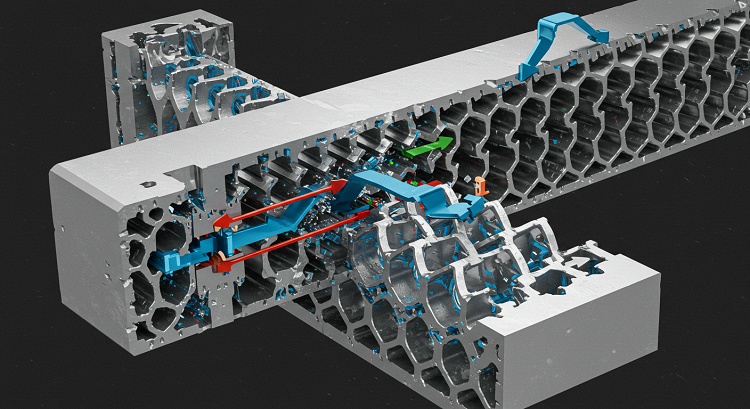
As the need for improved thermal control continues to grow while reducing the size, engineers are rethinking all aspects of the heat exchanger design, starting with one of the most important — the fin. Fins play an important role in microchannel heat exchangers, improving heat transfer by increasing the surface area and directing air flow through the coil. Recent developments in rib geometry, materials, and surface treatment have revolutionized productivity: microchannel devices are now more efficient, durable, and adaptable to a wide range of applications. Improved rib geometry for improved airflow
Traditional air conditioning systems usually use flat or corrugated aluminum fins with the same distance between them, but such configurations can lead to increased airflow resistance and uneven heat distribution, especially under variable load conditions. This problem is solved in new generation microchannel heat exchangers by using advanced rib profiling technologies that optimize air flow with minimal structural losses.
An even newer geometry of the fins includes variable angles of inclination of the blinds, staggered grilles and asymmetric gaps between them, which ensures maximum turbulence and uniform distribution of air flow through all microchannels. This not only increases thermal efficiency, but also reduces the pressure drop on the air surface, allowing fans to operate at lower speeds without compromising cooling capacity. The result is quieter operation, lower power consumption, and better temperature control — valuable advantages in commercial and industrial processes.
Durability of materials and coatings increases.
With the exception of aerodynamics, the choice of material and protective coatings played a key role in ensuring maximum durability of the fins. Aluminum remains the preferred material due to its low weight and thermal conductivity. However, exposure to humidity, salt spray, and air pollution can still degrade performance over time, especially outdoors or in industrial environments.
To avoid this, manufacturers have developed hydrophilic and anti-corrosion coatings that promote rapid condensate drainage and are resistant to chemical decomposition. These coatings are especially useful in coastal areas or in humid climates where corrosion is possible. Some models have an antimicrobial treatment that inhibits the growth of mold and bacteria on the surfaces of the ribs, which is especially important in healthcare, the food industry and clean rooms.
These improvements not only extend service life, but also shorten maintenance cycles and eliminate the need for expensive coil replacements. For equipment equipped with trane microchannel condenser coil, such improvements guarantee long-term reliability without compromising optimal thermal performance.
Integration with a compact system design
The increased demand for more compact and highly efficient air conditioning equipment has led to an increasing focus on compact design. Microchannel heat exchangers are already at the forefront in this regard, and fin’s new developments further contribute to the miniaturization of systems without compromising performance. With best-in-class heat transfer per unit volume, manufacturers can produce smaller devices that take up less installation space, which is ideal for rooftop installations, data center cooling modules, and multi-zone VRF systems.
Some high-quality microchannel coils are now offered with modular fins that easily adapt to airflow requirements. Regardless of whether the use is optimized for high static pressure or low noise conditions, the flexible design gives engineers greater freedom to integrate the system.
When upgrading existing Trane equipment, replacing microchannel condenser coils with upgraded fins is an easy way to improve performance without replacing the system. Most of the replaceable coils of the trane microchannel capacitor are manufactured to accommodate the size of the original equipment, but using the latest FIN technology, which ensures perfect compatibility and immediate efficiency improvements.
Looking to the future: Intelligent integration and performance monitoring
As intelligent air conditioning and digital control systems become the norm, the fin design is being improved, allowing for real-time performance monitoring. New-generation microchannel heat exchangers have built-in sensors that monitor deviations in air flow, temperature, and signs of contamination or clogging. With this integrated Smart system, preventive maintenance and proactive system configuration can be performed, which increases efficiency and reduces downtime.
In short, the development of microchannel heat exchanger fins is an expression of a broader trend in temperature management — precision, reliability, and flexibility are driving innovation. Improved airflow dynamics, increased corrosion resistance and intelligent integration – these technologies determine the future direction of HVAC and cooling systems development.
When installing or retrofitting the trane microchannel condenser coil, the effect of the innovative fin design is obvious: productivity is improved, service life is extended and cleaner operation is ensured. As the industry continues to expand its capabilities, microchannel heat exchangers prove that even the smallest elements can have dramatic effects.